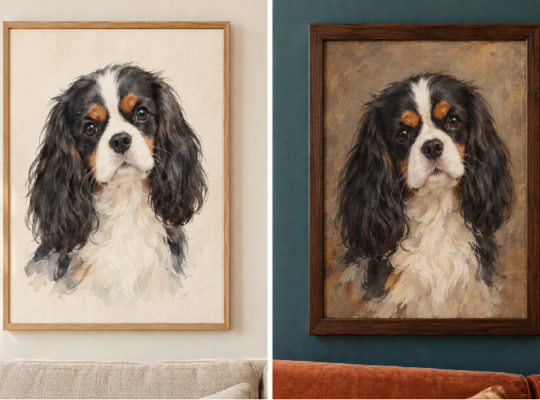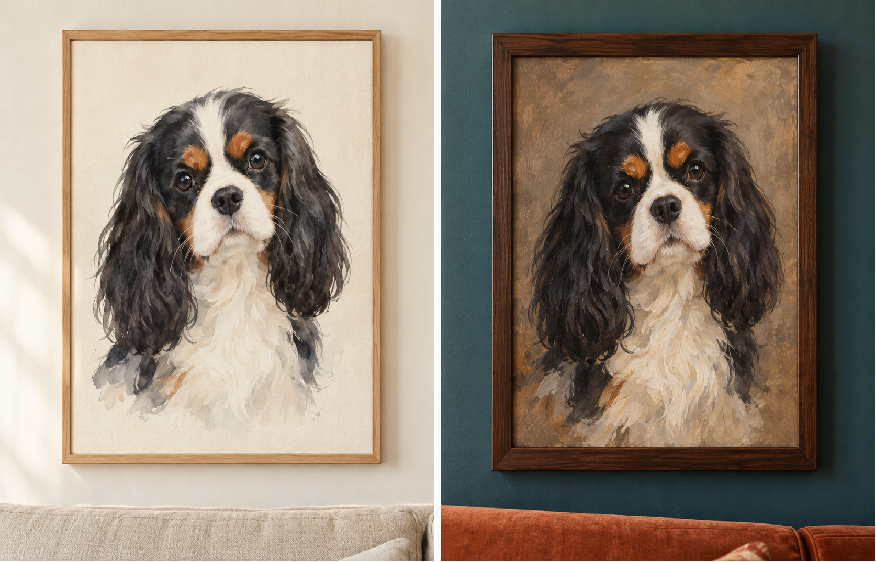

Two people can love the same pet and want quite different portraits. One may picture a quiet image near a desk; the other may prefer a playful piece on a living-room wall. Agreeing on the subject does not require agreeing on every part of the artwork.
If you are planning separate portraits for two homes, divide the decisions into two groups: the reference information you share and the order choices each person owns. This makes it easier to preserve the pet’s familiar details while allowing the finished pieces to belong in different spaces. It also gives the maker clearer instructions for each order.
Establish the shared reference information
Begin with the pet’s appearance, rather than the room or the product. Choose the photograph or reference set you want to start from, and identify what it is meant to show.
You may both want the same expression. You may prefer different views taken during the same period. Either can work as a planning choice, provided you do not assume that “the same pet” means the same reference decision has already been made.
Read More: The Aesthetic Trends Shaping Yacht Floristry in Monaco
Agree on a few visible identifying details. These might include an uneven marking, the familiar position of an ear, or a patch of color that you both want represented. Write them down in terms someone else can understand.
If your preferred photographs show different stages of the pet’s life or different appearances, make that explicit. Each person can choose an appearance that matters to them, but the files should not contradict the brief by accident.
Use clear filenames or labels, and ask before passing along another person’s photographs. Keep the shared set small enough that its purpose is obvious. A folder labeled only “pet pictures” is less useful than a main reference with two supporting images and a line explaining each one.
This shared note is a source of information, not a combined order. You will still need to decide what belongs in each individual request.
Let each home set its own display goal
Next, separate the preferences that do not need agreement. Each person can describe where the portrait will go, how prominent it should feel, and what sort of visual treatment they would enjoy.
For a hypothetical pair of orders, Home A might want a restrained image for a small personal space. Home B might want a more playful design for a shared room. The same recognizable pet can be the starting point for both, without requiring either person to compromise on the other home’s decor.
Keep the description practical. “I want the background to feel quiet” is more useful than assuming a room label automatically dictates a style. Likewise, name a preferred format or orientation as a choice to verify, rather than treating it as an option every design must offer.
You can browse custom pet portraits together, but save each person’s shortlisted design separately. The aim is to discover preferences, not to average two different ideas into a third picture neither person wanted.
When comparing the current offer at Pawfolio Art, identify the specific product each person is considering. Then confirm its options independently. Sharing a reference image does not establish that two different products have identical choices or will produce the same composition.
Create two briefs that can stand on their own
Write a complete brief for each portrait, even if some lines repeat. Each should identify the intended reference, the selected design, the requested emphasis, and the person responsible for answering questions.
Avoid relying on phrases such as “same as the other order, except more colorful.” The maker may need the relevant files and instructions supplied with each order. Ask how related orders should be identified if you want their connection noted.
An illustrative pair might look like this:
- Home A: Use the seated reference for the expression. Keep the pale chest marking visible if the selected composition allows it. The preference is a quiet visual treatment. Questions and artwork review go to Person A.
- Home B: Use the same seated reference as the starting point. Keep the same identifying markings, but explore the selected playful design. Questions and artwork review go to Person B.
The examples explain intent; they do not confirm that a particular design supports every request. Essential requirements still need to be checked before ordering.
Include any selected name text separately from the account holder’s name. If one portrait will include lettering and the other will not, state that difference clearly where the relevant product offers the option.
Keep delivery details in the appropriate order fields. Do not assume that a shared discussion creates a combined transaction, a multi-address arrangement, or a special price. Ask about any arrangement you need instead of building the brief around an unconfirmed assumption.
Understand the process for each portrait
Before placing the orders, read how the chosen maker handles submitted photographs, artwork preparation, and customer review. For Pawfolio’s printed portraits, the guide to ordering and artwork review explains the steps leading to production.
Discuss who will respond for each order. Two people can share opinions privately while keeping one clear contact for the maker. If both want to see a preview, decide how to share it between yourselves rather than assuming the provider will coordinate that conversation automatically.
Treat each portrait’s approval as its own decision. Agreeing to one design does not mean the second design is also approved, even when they began with the same pet photo. If a shared reference detail changes, check whether it is relevant to both orders and communicate it clearly where needed.
Do not assume that artwork prepared for one purchase will automatically be reused for another. If reuse is important, ask what is possible for the selected products. A second portrait may involve different layout choices, and the applicable process needs confirmation.
The purpose of this planning is to prevent an ordinary preference from being mistaken for an instruction about both orders. Clear responsibility is particularly useful when one person is ready to decide and the other is still considering their options.
Keep a shared-and-separate decision sheet
Make a simple record with a shared section at the top and a separate column for each home below it. The shared section can list the reference files, the intended appearance, and the identifying details both people care about.
Under each home, record the selected design, format, available options chosen, contact person, and current approval status. Add the order reference once it exists. Keep the two columns distinct even when some entries happen to match.
If a decision changes, update the appropriate column rather than overwriting the shared reference note. For example, changing the background preference for one personalized pet portrait should not accidentally alter the other person’s instructions.
Save any relevant correspondence with the correct order. This is a coordination record, not a demand that the maker manage both households as one project. It helps you remember what was requested, what was confirmed, and which decision remains open.
You can use the sheet again if another family member later wants a separate portrait, while checking the current offer afresh.
Read More: Enjoying the Elegance of a Sanlorenzo Yacht Cruise: A Floating Paradise
It can also make timing less confusing. If one person is ready to order while the other is still choosing a design, record those different stages. Neither needs to be presented as a promise about when both portraits will be finished. Keep any date-related questions attached to the relevant order, and let the maker confirm what is possible for that purchase.
Keep the connection without requiring a match
Pet portraits from photos can begin with the same familiar face and lead to different finished choices. That is a reasonable outcome when the pictures are intended for different people and spaces.
Share the reference facts that matter, let each person own their preferences, and make every order understandable on its own. The connection between the portraits can come from recognizing the pet, while the differences reflect how each person wants to see that familiar face at home.